

Have you ever received a simple “K” in a text and wondered what it means? The K Meaning in Text is usually a short way to say “Okay.” But its tone can change depending on the conversation and the person using it.
In 2026, “K” is still common in texting, chats, and social media. It can show agreement, understanding, or a quick reply. Sometimes, it may sound cold or uninteresting. Knowing the context helps you understand what the sender really means.
Core Meaning & Intent: What “K” Stands For in Texting

In daily messaging, K serves as the shortest possible abbreviation for “Okay.” It is dropped into conversations to confirm plans, acknowledge information, or signal that a message has been received. Because typing a single letter requires minimal effort, it functions as a fast, low-energy reply designed to keep messaging brief.
Tone Analysis: Why a Single “K” Can Feel Cold or Rude
While typing “K” saves time, it frequently carries a cold, dry, or dismissive tone in personal relationships. Unlike typing “Okay,” “OK,” or “Sounds good,” sending just “K” strips away all conversational warmth. In emotional discussions, after a long message, or mid-argument, a single “K” often signals frustration, unbothered energy, or a desire to shut down the conversation entirely.
History & Digital Origins: From T9 Keypads to Modern DMs

The standalone “K” response emerged during the early 1990s SMS era, when mobile phones used T9 numeric keypads and cellular carriers charged per character or text block. Shortening words saves both time and money. As chat platforms like AOL Instant Messenger (AIM) grew and modern smartphones took over, “K” evolved from a practical typing shortcut into a culturally recognized symbol for emotional distance and passive aggression.
K Across Social Media (Snapchat, TikTok, Instagram & WhatsApp)

The social perception of “K” adapts slightly depending on which messaging platform you are using:
- WhatsApp: Often signals that a conversation is finished. Between close friends, it means “got it,” but in serious chats, it creates immediate tension.
- Snapchat: Used as a low-effort snap reply or streak keeper, signaling that the user isn’t in the mood for a lengthy chat.
- TikTok: Frequently dropped in comment sections as a passive-aggressive shutdown or to project an unbothered, edgy online persona.
- Instagram DMs: Conveys dry, distant energy, especially when replying to long stories or detailed direct messages.
Real-World Chat Examples: How “K” Lands in Conversation

The emotional impact of “K” shifts dramatically based on the scenario:
- Neutral Confirmation: “I’ll pick you up at 6 PM.” → “K” (Got it, see you then).
- Passive-Aggressive / Cold: “I really didn’t appreciate how you spoke to me earlier.” → “K” (I am shutting down this discussion).
- Unprofessional: “Please submit the quarterly report by noon.” → “K” (Comes across as dismissive and disrespectful in work chats).
Gender & Relationship Dynamics: “K” From a Girl vs. a Boy
From a Girl:
- Often carries intentional emotional weight. When sent during a tense moment or after a detailed text, it frequently signals annoyance, disappointment, or a boundary indicating she wants you to notice her frustration.
From a Boy:
- More commonly used as a literal, fast typing shortcut. Guys often send “K” purely to acknowledge information without intending any hidden hostility or passive-aggressiveness.
Comparison: K vs. OK vs. Okay vs. Sure
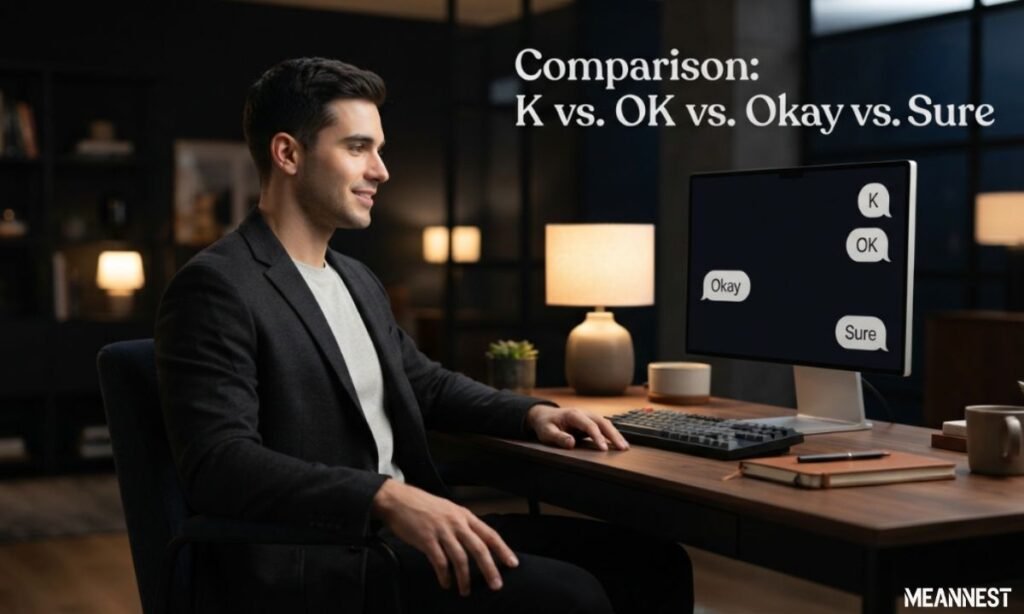
| Text Reply | Emotional Tone | Perceived Effort | Recommended Use Case |
| K | Cold, abrupt, or dismissive | Extremely Low | Casual confirmation between best friends only |
| OK | Neutral, direct, objective | Moderate | Quick updates, casual plans, informal check-ins |
| Okay | Warm, polite, attentive | Standard | General texting, dating apps, friendly chats |
| Sure | Casual, agreeable, relaxed | Standard | Agreeing to requests or casual invitations |
| Noted / Understood | Professional, respectful | High | Corporate emails, workplace Slack, client chats |
Street Slang & Urban Meaning: “K” in Hood Culture
In street and hood slang, “K” serves two distinct purposes depending on the topic. In conversation, it acts as a low-effort acknowledgment meaning “heard you.” When discussing money or finance, “K” stands for a thousand dollars (e.g., “He made 5K last night”), derived from the metric prefix kilo-.
Non-Texting Definitions: Science, Math & Finance

Outside of social media slang, the single letter K holds vital official meanings across technical disciplines:
- Financial & Business: Represents thousands (e.g., $50K = $50,000).
- Chemistry: Symbol for the element Potassium on the periodic table.
- Physics: Unit symbol for Kelvin, the primary scale of thermodynamic temperature.
- Mathematics: Represents a constant variable in algebraic equations.
- Sports (Baseball): The official scorecard symbol for a strikeout.
How to Respond When Someone Texts You “K”

When receiving a dry “K,” your response should match the situation and your relationship with the sender:
- Match Their Energy: Reply with a brief “Cool” or “Sounds good” to keep your composure.
- Restart Smoothly: Ask a direct follow-up question if you need clear details (e.g., “Are we still meeting at 5?”).
- Dissolve Tension: Use light humor or a playful meme if you suspect they are teasing.
- Give Space: If sent mid-argument, avoid sending immediate double-texts; let the conversation breathe before re-engaging.
Workplace Etiquette: Why You Should Never Send “K” to a Boss or Client
In professional communication, replying with a standalone “K” is a major etiquette mistake. Supervisors, colleagues, and clients view a single-letter reply as lazy, careless, and unprofessional. In work messaging platforms like Slack, Microsoft Teams, or email, always replace “K” with polished alternatives such as “Understood,” “Will do,” “Noted,” or “Thanks for the update.”
Online Dating & App Culture: How “K” Affects Matches

On dating apps like Tinder, Bumble, or Hinge, sending “K” is a quick way to kill conversation momentum. Early dating relies on mutual effort and enthusiasm; replying with a single letter signals low interest, emotional unavailability, or dry communication, prompting matches to move on quickly.
Common Misinterpretations & Communication Pitfalls
- Confusing Speed with Hostility: Assuming a rushed “K” sent by a busy friend automatically means they are angry at you.
- Ignoring Context: Failing to realize that dropping “K” after an apology or emotional disclosure feels deeply hurtful.
- Typo Errors: Accidentally sending “K” when attempting to type words starting with K, leading to awkward miscommunications.
Friendly & Warm Alternatives to Use Instead of “K”

To prevent your text messages from sounding harsh or uninterested, consider swapping out “K” for warmer alternatives:
- “Okay!” or “Sounds good!”
- “Got it, thanks!”
- “Perfect, see you then.”
- “All good!”
How Context Determines the True Meaning of “K”

Ultimately, interpreting “K” requires evaluating three key factors: who sent it, when it was sent, and what was said right before it. A quick “K” from a close friend confirming a meet-up time is completely harmless, whereas a “K” sent by a partner after a serious conversation signals that an open discussion is needed.
Frequently Asked Questions
What does “K” mean in text messages?
In text messages, K is a short abbreviation for “Okay,” used to confirm or acknowledge a message quickly.
Is sending “K” considered rude in texting?
While not inherently rude, sending just “K” can feel cold, dismissive, or passive-aggressive, especially in personal or emotional conversations.
What is the difference between “K”, “OK”, and “Okay”?
“Okay” is warm and polite, “OK” is neutral and standard, while “K” is extremely short and often perceived as cold or low-effort.
What does it mean when a girl texts “K”?
When a girl texts “K,” it often indicates she is annoyed, busy, disinterested, or ending the conversation quickly without warmth.
Why do people use “K” instead of “OK”?
People use “K” to save time and type fast. However, some use it intentionally to express frustration or keep their distance in a chat.
Can I use “K” in work emails or professional chats?
No. Using “K” in professional chats looks lazy and disrespectful. Always use formal alternatives like “Noted,” “Understood,” or “Will do.”
What does “K” mean in finance and numbers?
In finance and general numbers, K stands for thousand (e.g., $10K means ten thousand dollars).
Conclusion
Now you know the K Meaning in Text and how people use it in daily chats. “K” usually means “Okay” or shows that someone understands. However, its tone can change based on the conversation and context.
In 2026, “K” remains a quick and common texting reply. It can sound friendly, neutral, or a little cold in some situations. Always consider the sender’s words and the situation before judging the meaning.

Michael is a creative writer with 4 years of experience exploring meanings and clever puns through his blog. He now works at Meannest.com, where he continues crafting engaging, witty content that connects ideas, language, and humor for readers worldwide diverse.
